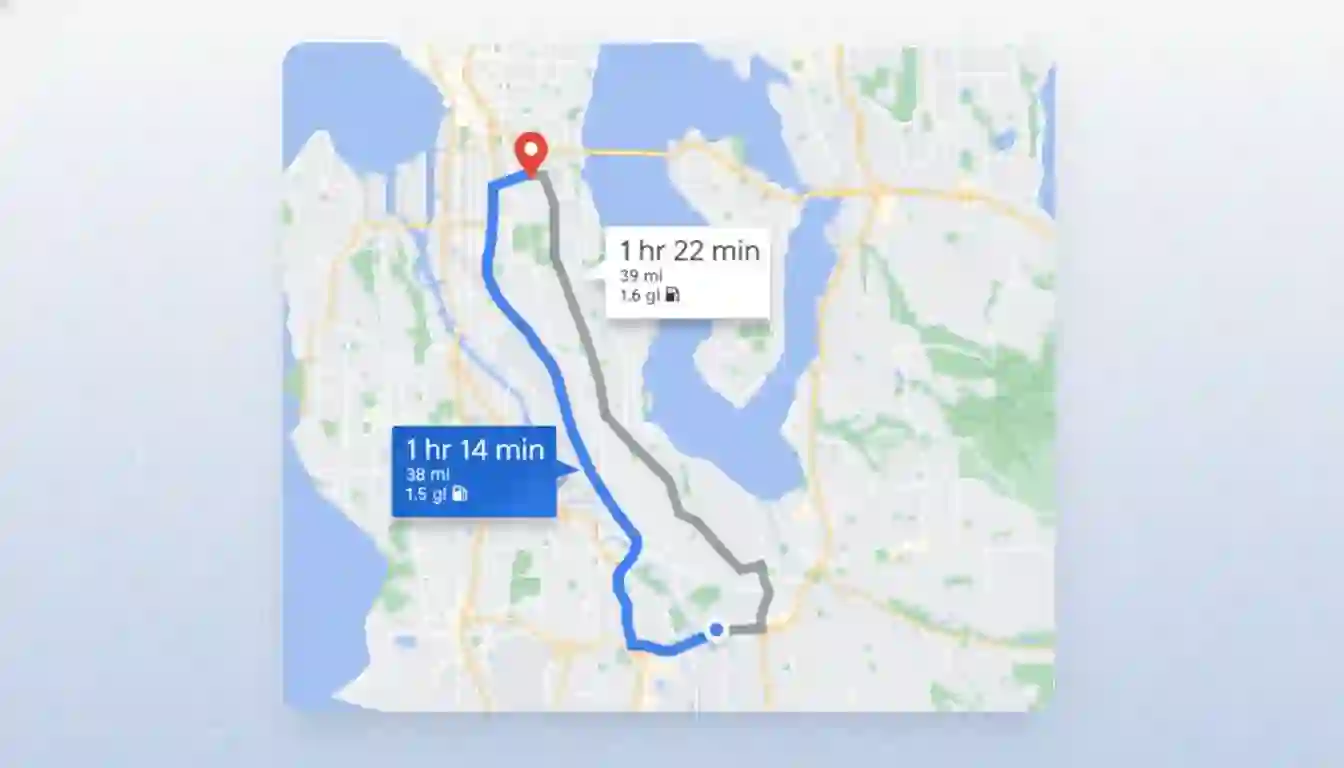
Google Maps dominates turn-by-turn navigation for billions, yet its route options remain rudimentary—avoid tolls, highways, ferries, or fuel-efficient paths. Real drivers face complex trade-offs ignored by current toggles: truckers need weight limits, families want night safety, EV owners seek chargers, and everyone towing trailers dreads steep grades.[web:532][web:541]
Current Limitations Exposed by Data
NHTSA reports 55% of fatal crashes occur on rural roads despite low traffic volume. NCAR research shows rain spikes crash risk 70%; unlit shortcuts prove deadly. INRIX congestion analytics reveal 5-minute “fastest” routes vary 40% daily reliability. Maps’ binary toggles fail these scenarios.[web:532]
High-Impact Route Profiles Drivers Demand
- Night Safety: Lit arterials, protected lefts, avoid dark two-lanes (IIHS crash data)
- Paved Roads Only: Skip gravel/washboard (Waze precedent)
- Weather Optimized: Low-risk during rain/snow (maintenance priority routes)
- Trailer/RV Mode: Clearance limits, turn radii, weight restrictions
- Reliable ETA: 90% on-time vs fastest (INRIX volatility-adjusted)
- Fewer Complex Intersections: UPS left-turn avoidance (+$400M savings)
Proven Competitor Features Missing from Maps
| Feature | Waze | TomTom/Garmin | Apple Maps | Google Maps |
|---|---|---|---|---|
| Dirt Road Avoidance | ✓ Limited cities | ✓ Vehicle profiles | ✗ | ✗ |
| Trailer Profiles | ✗ | ✓ Full | EV charging | Fuel eco only |
| Weather Routing | Hazards | Basic | ✗ | ✗ |
| Intersection Difficulty | ✓ Some | ✓ | ✗ | ✗ |
Technical Implementation Roadmap
Google Maps Platform already supports Route Optimization API (25 waypoints max) with traffic-aware, eco-routing, toll data. Consumer Maps lags behind developer tools.[web:532][web:536]
- Leverage crowdsourced telemetry (potholes, gravel)
- IIHS/NHTSA crash databases (intersection safety)
- State DOT feeds (maintenance priority, closures)
- INRIX volatility scoring (ETA reliability)
- Vehicle profiles via Android Auto (trailer weights)
Voice-Controlled Smart Routing
Generative AI enables natural commands: “Airport via paved roads” or “Safest night route downtown.” Gemini integration already powers Lens identification; extend to route constraints. Physical Android Auto/CarPlay toggles ensure reliability when voice fails.[web:541]
Urban Planning Benefits
Cities battle navigation-induced cut-through traffic. “Arterial-preferred” routing reduces residential spillover 30% (LA pilot data). Transparent safety metrics prevent algorithmic redlining—roadway crash stats over socioeconomic proxies.[web:533]
User Interface Presets (5-Toggle Maximum)
- Everyday: Balanced time/fuel
- Storm: Low-risk weather routing
- Night: Lit arterials + protected turns
- Towing: Clearance/grade optimized
- Reliable: 90th percentile ETA
Each displays trade-offs: “+2min / -15% fuel / +25% safety score.”
Monetization & Enterprise Synergy
Consumer Maps gains from existing APIs; enterprises access premium profiles (trailer fleets). Eco-routing shows CO2 savings; insurers offer discounts for safety modes. 16% travel time reduction proven via traffic data alone.[web:540]
Competitive Pressure Mounting
- Apple Maps: EV charging + CarPlay depth
- Waze: Community hazards/avoidance
- TomTom: Vehicle-specific routing
- NextBillion.ai: Real-time multi-stop optimization
Implementation Priority Matrix
| Feature | Difficulty | Safety Impact | Fuel Savings |
|---|---|---|---|
| Paved Roads | Low | High | Medium |
| Night Safety | Medium | High | Low |
| Trailer Mode | High | Medium | High |
Google Maps’ waypoint optimization (98 lat/lng max) proves technical feasibility. Smart defaults + 5 presets convert navigation from commodity to co-pilot. Shortest ≠ safest; give drivers control.[web:536]